
I’ve never had the chance to work with Ruby on Rails. I always had the impression that Rails was one of those technologies that had been around forever, had survived every trend, and was probably pretty solid because of that. That was basically the extent of my knowledge.
Somehow, after years working as a developer, I also didn’t know much about David Heinemeier Hansson, DHH, the creator of Rails, or the whole ecosystem around him. Then his recent Rails World 2026 keynote started showing up everywhere. People were talking about it a lot. Some loved it, some absolutely hated it, and I kept seeing comments like “DHH has gone off the rails.”
So, of course, I had to watch it. And now I get it.
Nobody should be writing code manually anymore
It sounds crazy when you say it like that, but it also feels like one of the most honest and unfiltered takes I’ve heard about where software development is heading. DHH’s point is basically that AI agents are becoming a new programming interface. Not autocomplete, not a chatbot sitting next to your editor, but an interface.
And I think he’s right.
We haven’t always programmed computers using high-level languages. Over time, abstractions allowed us to move further away from binary and machine instructions. Then came assembly, C, higher-level languages, libraries, frameworks, IDEs, and more layers that let us focus less on every tiny instruction and more on what we actually wanted to build.
AI agents feel like another step in that direction. Instead of manually translating an idea into thousands of lines of code, we’re starting to describe a goal, provide context, define constraints, review what comes back, and iterate.
The programming language doesn’t disappear, and the developer doesn’t disappear. But the way we interact with the machine is changing. Whether you like DHH or hate the way he says things out loud is a separate discussion. On this point, I agree with him.
This is a great time to be a developer
And I don’t mean that in the usual “AI is going to change everything” hype kind of way. I’m genuinely excited about what this lets us do.
I can move faster, ship more, and investigate ideas that I probably would have ignored before because they weren’t worth the time. I can try a language I barely know, explore a different framework, test an architecture, dig into infrastructure, mess with my operating system, or build a prototype just to see if an idea is worth anything.
Things that used to start with “I’d love to try that someday” can now start with “Let’s see if we can build it.”
That shift is huge.
AI doesn’t magically give you good judgment. It doesn’t understand your product better than you do, it doesn’t make architecture irrelevant, and it definitely doesn’t guarantee good software. But it dramatically lowers the cost of exploring, and for developers who are naturally curious, that’s incredibly powerful.
You still have to reinvent yourself
This is probably the uncomfortable part. Every big technological change creates resistance, and that’s normal. People spend years becoming very good at doing things a certain way, and suddenly the rules start changing.
I think the mistake would be assuming that working with AI is just about learning how to write better prompts. That’s probably the least interesting part.
The real skill is learning how to work with these systems properly. How do you give an agent enough context without drowning it? How do you explain the actual problem instead of just the task? How do you set constraints, verify the result, catch a bad architectural decision, split work between multiple agents, and maintain a codebase where you didn’t personally type every line?
Those questions are becoming part of software engineering.
The skill is no longer just writing code. It’s also learning how to delegate engineering work well.
Then there’s Omarchy
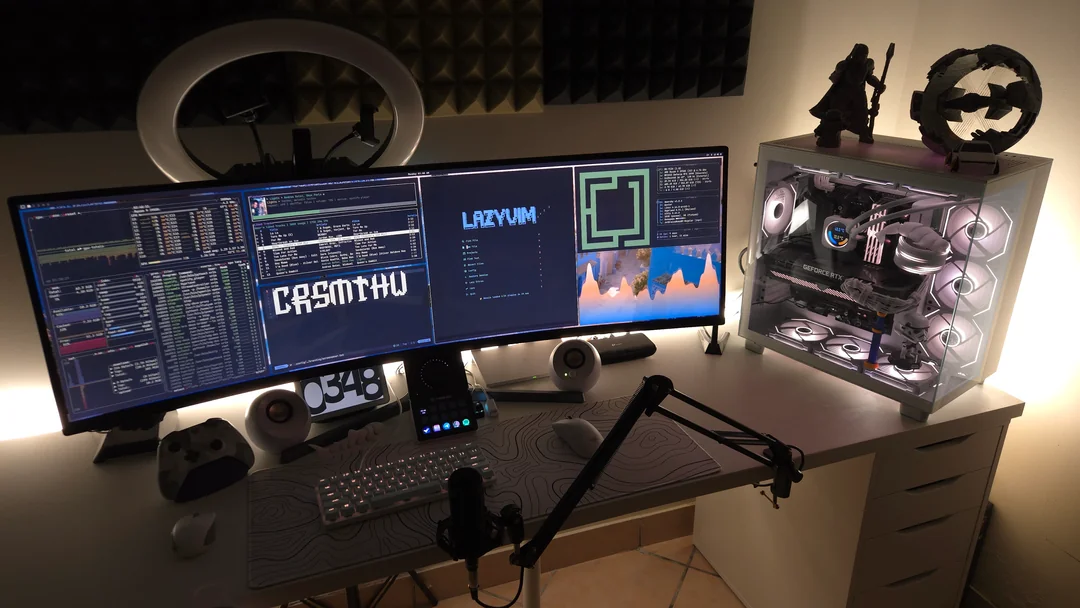
This whole thing also made something else click for me.
DHH is behind Omarchy, an opinionated Linux setup built around Arch Linux and Hyprland. And if there’s one thing Linux communities are never short on, it’s opinions.
I’ve seen plenty of criticism around Omarchy. Why use somebody else’s Arch configuration? Why not configure everything yourself? Why this distro? Why this tool? Why that default?
Fair questions.
But when I actually looked into it, something funny happened: it checked almost every box I had. So I installed it, and I’m writing this article from Omarchy.
It’s simple, fast, stable, and most importantly, it gets out of my way. No complaints.
After listening to DHH talk about AI, Omarchy makes even more sense to me. If I want to change something in my OS now, I often don’t spend hours digging through documentation, random forum posts, config files, and old GitHub issues. I open an agent, explain what I want, let it investigate the system, find the relevant files, and propose a change. Then I review it and move on.
That experience changed the way I think about AI.
AI is not just about chatting with a robot
For a while, I think most people saw AI as a chatbot. Open ChatGPT, ask a question, get an answer. Maybe summarize something, write an email, or generate some text.
And sure, that’s useful. But it feels like such a small part of what this technology is becoming.
AI is increasingly about building. Building code, architecture, infrastructure, operating systems, drivers, patches, games, tools, and things that previously required a huge amount of specialized knowledge just to get started.
That’s where it becomes really interesting to me.
And we’re still early. There are probably entire categories of software, tools, interfaces, and workflows that we haven’t even imagined yet. That’s the part I find exciting.
Maybe the developer’s job is simply moving up the stack
I don’t think programming is dying. I think we’re moving one level higher again.
We moved from machine code to programming languages, from programming languages to frameworks, and from frameworks to increasingly powerful development environments. Now we’re starting to move from directly telling the computer exactly how to do something toward systems that can translate our intent into implementation.
That doesn’t make understanding software less important. I think it makes it even more valuable.
If implementation becomes cheaper, then knowing what should be built, why it should be built, how the pieces should fit together, what trade-offs are acceptable, and whether the result is actually good becomes even more important.
Maybe we’ll write a lot less code manually. I’m completely fine with that.
I didn’t become a developer because I enjoy typing semicolons. I became a developer because I like building things.
And right now, it feels like we’ve just been handed a ridiculously powerful new set of tools.
I’m excited to see what we build with them.